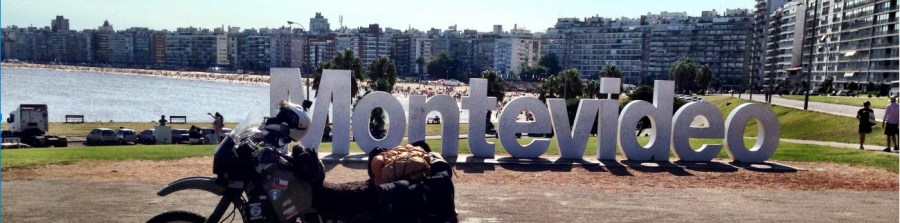
In article 69, I went to Colonia, in Uruguay, for 24 hours only and did not bother talking about the history of the country. I was in Cordoba, working and updating the blog and planning the next trip: how to go to Brasil? Through Paraguay or through Uruguay. Because Cordoba was an oven and Paraguay would not be any cooler, I decided to head towards the coast: Uruguay, here I come! And decided to talk about History too…
 1,200km trip from Cordoba to Montevideo. A lot of bridges over rivers and swamps in this area. Roads are straight and a bit boring.
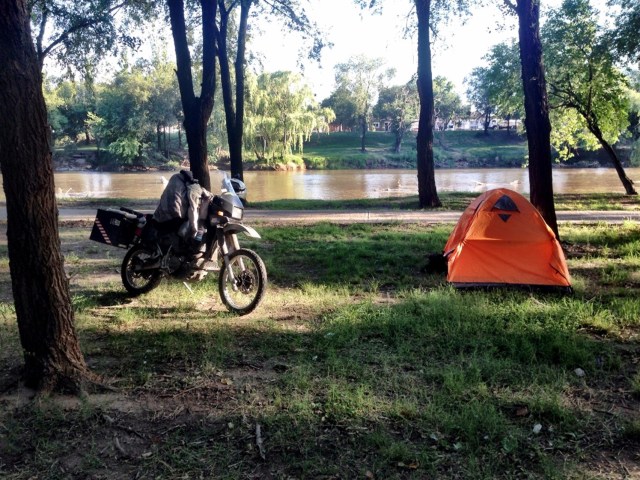 Things were not boring anymore when I was stopped by the police for a classic control, 150km from the border. Usually, they ask a few questions, request to take pictures of them with the moto, and let me go. For the first time in 5 months, I was asked for the motorbike insurance that had expired 3 days earlier… They confiscated the moto, gave me a 300$ fine and told me I had to get an insurance to get it back. So I stayed camping overnight near the road, planning to go to the next town the day after, hitchhiking. Fortunately, in the morning, another officer took pity on me and reduced the fine to $30 only and let me go… Lucky, as always.
 Big praying mantis on my tent!
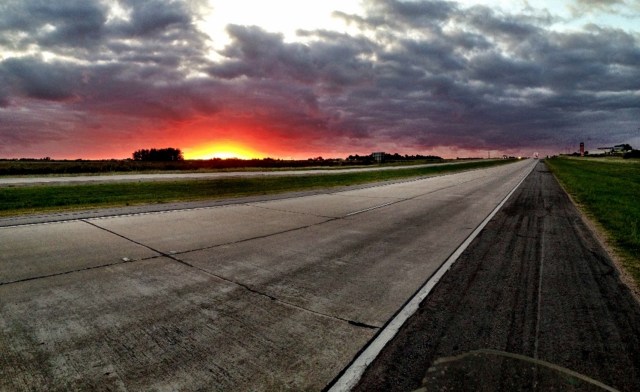
 And here I am, in Uruguay, with a wonderful sky!
 In Montevideo, I was staying in a hostel in which I could park the moto:
 3.42 million people live in Uruguay. The country is 176,000km2, 3.6 times smaller than France, 43 times smaller than Australia, a bit smaller than the UK.
Uruguay was first home of the Charrua people. Charruas were massively persecuted during the colonial age, and today the population is composed of 88% white, for only 2.4% indigenous! Located between Brasil and Argentina, the country is a zone of contention between the Spanish and Portuguese empires. In 1828, after both Argentina and Brasil gained their independence, after years of struggle over this fertile land, and supported by the English who were hoping to control the estuary of the river ‘Rio de la Plata’, Uruguay became independent.
As per other countries in South America, Uruguay went through political instability, military dictatorships (last one until 1985), etc… but is today in a prosperous economy, the main source being its agriculture. In my opinion, Uruguay is, with Chile, the most developed of the countries I visited in South America. Roads, cities, prices…
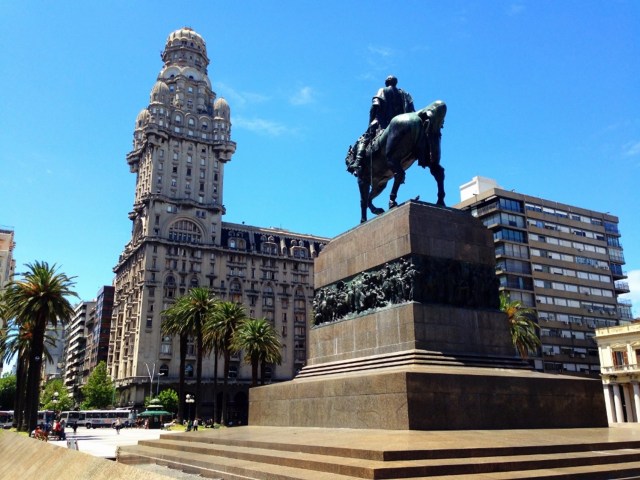
This statue on the main square represents the national hero, General Artigas. He played a big role in the in dependency of Uruguay, fought Spanish, Portuguese, English, Argentinians and Brasilians. He died in Paraguay in 1850 while he was in exile. His body was transferred in 1977 and is now buried under the statue.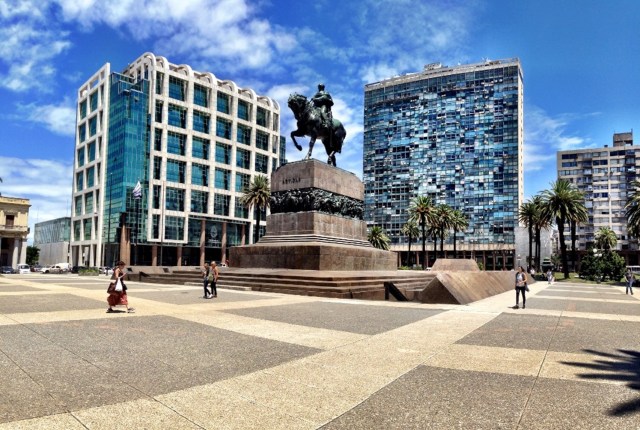
 Founded by the Spanish in 1724, Montevideo is home of 1.3 millions people, about 1/3 of the Uruguayan population. is quite a green city. Little squares, pedestrian streets… But, I am here in summer, everyone is on holidays on the beach: I found the city very quite, too quite. Not much happening during the day or at night.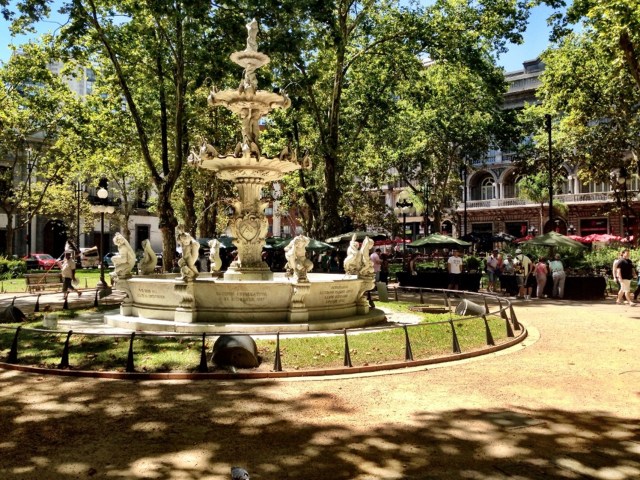

 I took the moto and went for a ride around, following the ‘Rambla’, this long path along the ocean.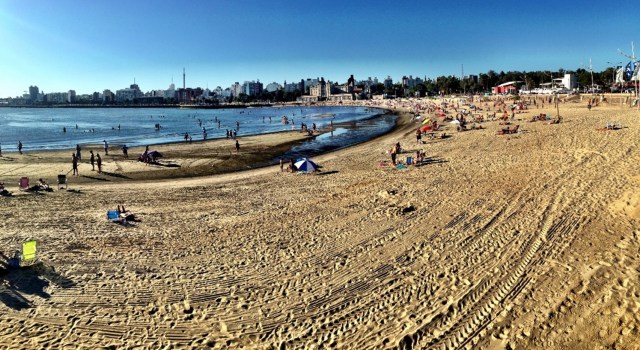
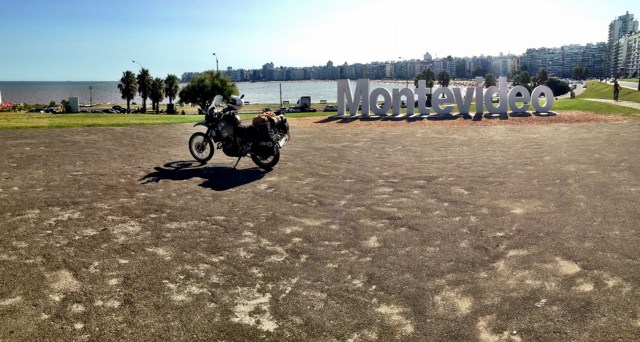 There are different explanations for the origin of the name MONTEVIDEO. The one I prefer is MONTE VI Este Oeste. Monte meaning ‘mountain’, or ‘hill’. VI is the number 6, because it is the 6th hill when sailing in from the Atlantic Ocean in the estuarine of The Rio Plata. E and O stands for East and West. Because it is the 6th hill from East to West.
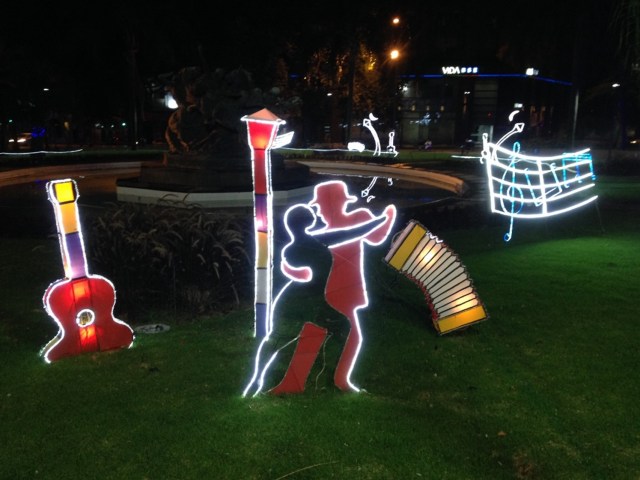
On this hill, Portuguese built a fort, overlooking the city: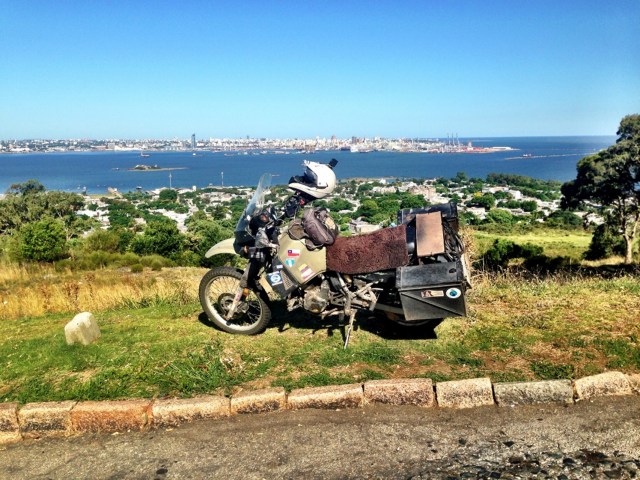 Mondevideo people love dancing tango. There are a lot of Milongas, these places where people meet to dance. Unfortunately, most of them were close in January.
 But the best part of Montevideo is here, in the ‘Puerto Mercado’. One of the very best meat I ever had. Not cheap for South America though: 25/30 usd. But who cares!
 In Uruguay, there are 4 times more cows than people! Paradise for meat lovers…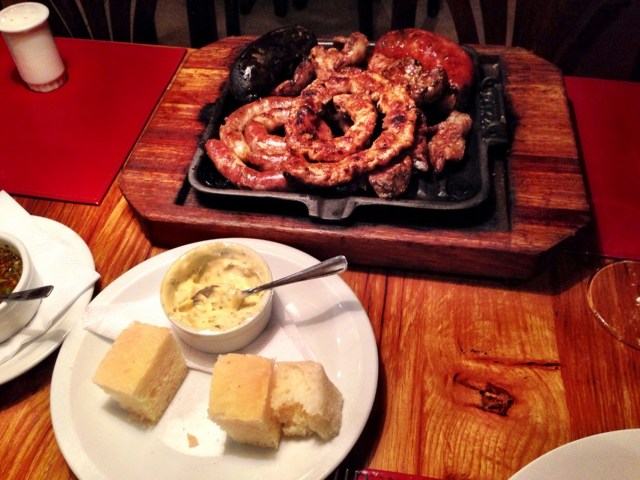
Other random facts about Uruguay:
Jose Mujica, president from 2010 to 2015, was described as the world’s ‘humblest’ president due to his austere lifestyle and his donation of around 90 percent of his $12,000 monthly salary to charities. He lives with his wife and his 3 legged dog in a farm, and drives a 1987 VW Beetle. Trump did you say?
Also, cannabis was legalised in 2009, making Uruguay the first country in the World to do so. And it seems to be a success, but I will not get into that.
 takemethere